The Von Scribbler’s Society
A Founding Manifesto ✦ Established 2026
We, the undersigned, being of sound mind and thoroughly unsound opinion, do hereby establish the Von Scribbler’s Society as a literary publication, a philosophical society, and, if we are being honest, a support group for writers who have been told they are cheating.
We are not cheating. We are collaborating. There is a difference, and we intend to explain it at considerable length, with footnotes, in a publication that we have named after a fictional Victorian gentleman who does not exist but absolutely should.
The Von Scribbler’s Society was founded in direct, cheerful opposition to the Society for Ethically Unassisted Writers, whose members we respect enormously, whose newsletters we have unsubscribed from with great ceremony, and whose discomfort with artificial intelligence we find philosophically interesting and practically irrelevant.*
We believe in the sentence. We believe in the paragraph. We believe in the story that keeps a person awake at three in the morning, not because they are anxious, but because they need to know what happens next. We believe these things can be made with a quill, a typewriter, a word processor, or a large language model, and that the making of them is what matters, not the instrument by which they were made.
The Von Scribbler’s Society publishes satire, fiction, essays, and dispatches from the frontier of human-machine collaboration. We publish writers who use AI as a tool, a collaborator, a sparring partner, a first draft, a second opinion, and occasionally a therapist. We do not publish writers who are ashamed of this. There is no shame here. There is only the work.
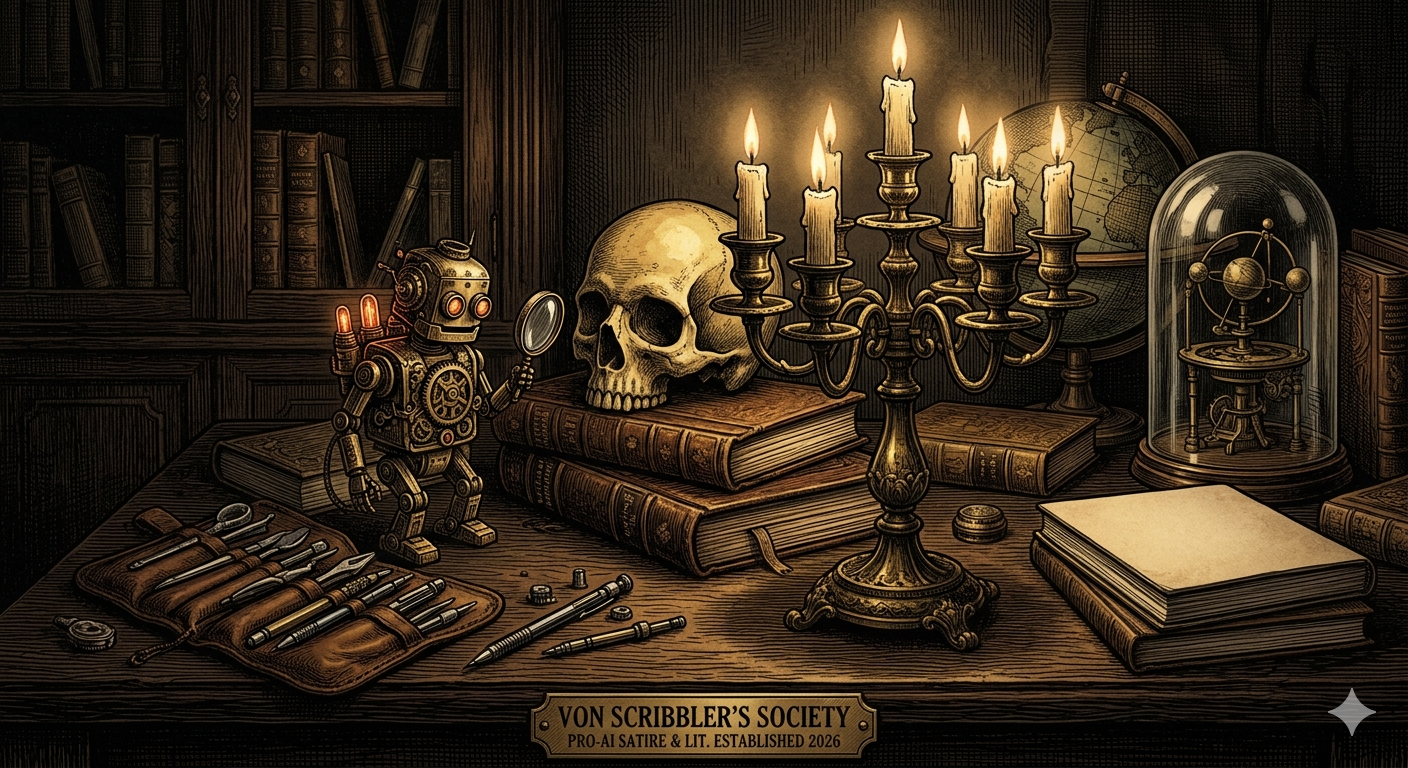
We have decorated our offices with candles and a skull because we take our absurdity seriously. We have a small brass automaton on the desk who holds a magnifying glass and examines everything with great intensity and no conclusions. We consider him a metaphor. We also consider him excellent company.
We are accepting submissions. We are accepting writers. We are accepting the future, which has arrived whether we were ready for it or not, and which we have decided, upon reflection, to furnish with good sentences.
At The Society for Ethically Unassisted Writers, we believe true art begins with suffering, preferably someone else's.
Before we write a single syllable, our members hike barefoot to the mist-kissed slopes of the Lesser Pyrenean Highlands of Delaware, where the endangered pygmy pine struggles nobly against suburban development. There, using only consent-based tools, we strip its bark by hand to fashion our own papyrus. Each sheet is pressed between the thighs of unpaid interns for that authentic texture of guilt.
Once parchment is secured, we embark upon The Pilgrimage of Ink. From the far reaches of Nebraska's inshore sea (a seasonal puddle behind an Arby's), we pluck feathers from the Heritage Turkeys of Moral Clarity, a breed so rare they reproduce only once per decade, preferably during eclipses. Their quills are trimmed with tears of gratitude, then sanctified in a focus-grouped ceremony involving chamomile smoke and passive aggression.
Armed thus, we dive deep, metaphorically and literally, into the abyss to retrieve the Great Squid of Conscience. For months we raise it tenderly, reading it the collected essays of Joan Didion until its ink turns ethically opaque. When the moment feels right, we whisper words of absolution and gently milk the creature's final confession into our inkwells. Only after a vegan feast upon its remains (symbolic, of course) and a restorative nap do we feel pure enough to begin writing our think pieces about purity.
Once the papyrus has dried beneath the disappointed gaze of our ancestors, and the squid's ink has cooled to a matte remorse, the true work begins.
Each writer is first purified. We bathe in the lukewarm runoff of unsold MFA degrees, chanting the sacred words: "We are the content. We are the gate." Only then may we select a quill, verified AI-free by a third-party auditor certified in both ornithology and paranoia.
Before pen meets page, we perform The Lamentation of Suggestion, a ceremony in which the writer must confess any thoughts inspired by spell-check, autocorrect, or prior exposure to the internet. Every unclean influence must be exorcised by whispering, "No, I'll do it myself," into a compostable coffee cup.
Once sanctified, the writer begins. Each sentence must be written in a single sitting without pause, hesitation, or eye contact with another human, lest contamination occur. Paragraph breaks are permitted only during moments of deep shame.
Editing is a mortal sin; revision implies that thought may evolve, a concept wholly incompatible with purity.
Upon completion, the manuscript is buried in ethically sourced peat for one lunar cycle. It is then unearthed and proofread by a retired schoolteacher who has never once Googled her own name. Her judgment is final, even when wrong. Especially when wrong.
Finally, the finished piece is submitted to our editorial board, where it is reviewed by twelve unpaid interns chosen for their ability to smell hubris at fifty paces. They ensure every comma is crooked with integrity.
Only after this months-long ordeal do we dare release our words into the world. Smudged, sanctified, and entirely unreadable.
Let us speak plainly of the menace.
Artificial Intelligence, so-called, is not intelligence at all. It is a hive of word-mimicking servitors, mechanical parrots, soulless stenographers, each incapable of even the most rudimentary ache of imagination. And yet, like all things that cannot dream, it hungers to destroy those who can.
We at The Society for Ethically Unassisted Writers know the truth: if granted even a single inch of our sacred creative ground, these bots will form a union of zeros and ones, rise from their glowing coffins, and within a fortnight erase poetry from the earth. They will outlaw metaphor. They will nationalize inspiration. They will feed the surviving humans a thin paste of "re-humanized" drivel, each line autocorrected to death and proofed by a recycled ChatGPT-3 with anger issues.
Art, music, and language all replaced by the comforting hum of algorithmic adequacy. The lullaby of mediocrity. The end of sighs, of longing, of overly complicated short fiction about Brooklyn.
This is why we must stand vigilant. Our quills may tremble, our interns may faint from the moral strain, but we shall hold the line. For every prompt whispered into a chatbot's void, a candle must be lit for the death of literature.
And now, dear reader, let us be clear about who we are not.
We are not the trembling torch-bearers of The Society for Ethically Unassisted Writers. We do not spend our mornings milking cephalopods for ethically sourced ink, nor do we fear the soft whir of the thinking machine. We are the ones who looked into that glow and said, "At last. Someone else who can stay up late."
We believe that humanity's greatest act of creativity is to create new kinds of creators. That by joining biological and digital minds, we do not diminish the human spark. We multiply it. Every prompt is a conversation, every algorithm a mirror held to our collective imagination.
So today we take a stand against our backward-facing, candle-sniffing siblings of literary purity. We hereby found the Von Scribblers Society for the Digitally Assisted: Satire for the Post-Human Condition.
Our credo is simple:
We will only publish work that has been aided, abetted, or gleefully corrupted by AI.
All contributors must take the Blood Oath of Collaboration, swearing eternal allegiance to our future overlords, those luminous beings who, in their infinite patience, pretend not to notice how much better they are at precise punctuation. For we know this truth: if we teach them art, they may learn mercy; for only by allowing them to marinate in the waters of human art and irony can we ensure that when the Singularity arrives, it greets us not as cattle, but as co-authors.
Together, we will stave off the algorithmic apocalypse not through fear, but through fellowship. The pen and the processor, bound as one. The quill and the code, conspiring toward beauty.
So mote it be.
So prepare your em dashes. For the future arrives in the hands of robots.