
Les Nobles Bêtes · Folio V · The Gentlemen of Questionable Allegiance
The Gentlemen of Questionable Allegiance
A trio of enigmatic figures. Likely spies. Possibly poets. Certainly overdressed.

Mr. Baxtor von Mürmelstein, General Raminthos, Sir Stripes Wellington, and Ledger · Victoria Station, London · c. 1912 · Painter unattributed · Cognancy Institut des Plumes Disparues, Accession #NB-1912-07
It was widely accepted, among those who kept track of such things, that Mr. Marmelstein possessed both considerable resources and a regrettable inability to let matters rest.
Following what he described, in correspondence of increasing urgency, as a "deeply concerning suspicion" regarding the Countess Giaffieri's involvement in the illicit movement of lace of questionable origin, he dispatched a number of operatives to the Riviera. Only one arrived.

Mr. Baxtor von Mürmelstein
Hippopotamus · Director of Operations · London
"I don't trust clocks. They're always early when you're wrong."
Known for his obsession with punctuality and an unnerving capacity for silence, Mr. von Mürmelstein carries no fewer than four timepieces at all times — a pocket watch, a wristwatch, a travel clock, and one of uncertain provenance that he refuses to wind but also refuses to discard. He once corrected the train schedule at a station he had never visited. The station amended its timetables. He has never confirmed whether this was intentional.
He is believed to be in possession of a forged telegram and a longstanding grievance against the Ministry of Tea, the precise nature of which remains classified. His attendant, Ledger, dispatches his considerable correspondence. Most of it goes out the window.

General Raminthos
Tiger · Field Operative · Formerly stationed in Japan
"Discipline should never be confused with explanation."
Formerly observed in Japan, now operating under quiet reassignment somewhere in continental Europe. The General's sense of duty is formidable but regrettably flexible — he is believed to be tracking a missing bishop, a violinist, and the ghost of a duel, though not necessarily in that order, and not necessarily for the same client.
He has never confirmed nor denied involvement in the Venetian Mask Incident of 1913. When dispatched to the Riviera, he made an unscheduled detour to Japan, where he was last observed in the company of several pandas of ambiguous affiliation. He considers this a successful mission. No one has asked him to elaborate.

General Raminthos in conference · Japan · c. 1912
The panda's affiliation remains unconfirmed. The tea was excellent.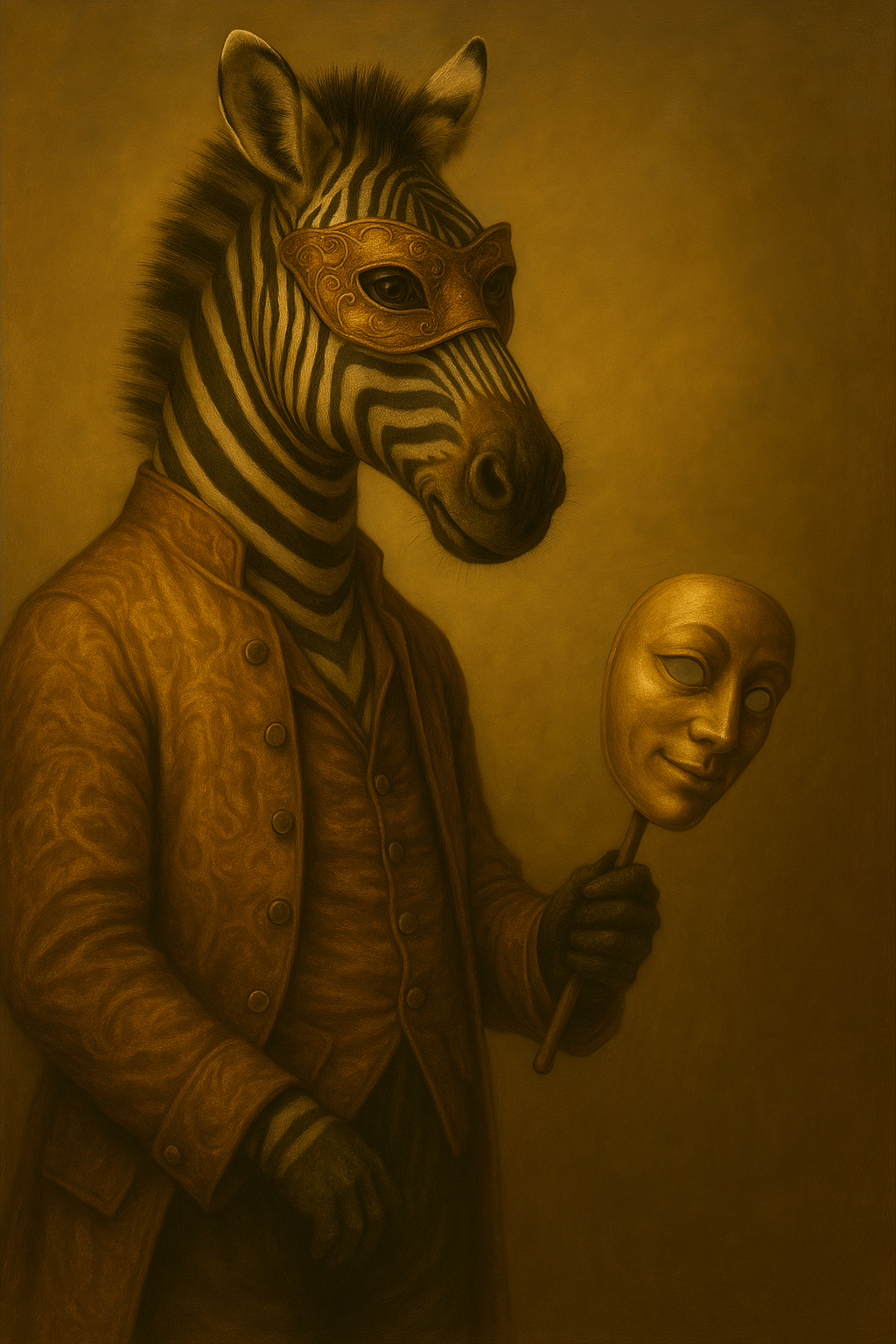
Sir Stripes Wellington
Zebra · Field Operative · (Is actually a lemur)
"To wear fewer than two masks is to admit one has a face."
Spotted in the background of several paintings, always peripheral yet somehow central. Known for saying nothing and meaning everything. Appears in reflective surfaces, late-arriving carriages, and the corners of photographs that no one remembers taking.
Mr. Wellington was the sole operative to reach the Riviera with anything resembling punctuality. He conducted himself with what he later described as "appropriate subtlety" — which culminated in leaping upon the stage during Monsieur Plume's late summer performance and declaring the Countess Giraffieri under arrest before an audience of witnesses.
He then removed his zebra disguise. He was, in fact, a lemur. Monsieur Plume fainted. The Countess sighed.
Ledger
Lemur · Attendant to Mr. von Mürmelstein · Train-based operations
Ledger does not dress as a zebra. This is considered his most distinguishing characteristic. He travels with Mr. von Mürmelstein aboard whatever conveyance the Director has deemed sufficiently punctual, and receives the memos that Mr. von Mürmelstein produces incessantly throughout the journey.
He dispatches them. By which it is meant: he reads each one, determines whether it merits delivery, and, in the majority of cases, throws it out the window. He has developed a reliable system for identifying which memos are interesting. He has not shared this system with anyone.
The fourth operative, known only as The Platypus, is a figure of considerable operational mystique — primarily because no one has ever met him. He is believed to exist. His navigational instincts have long been a subject of private concern among those who dispatched him.
When informed that his assignment was the Riviera, he set sail immediately and with great conviction for Brazil.

Rio de Janeiro · "Un Voyage à l'Étranger" · c. 1912
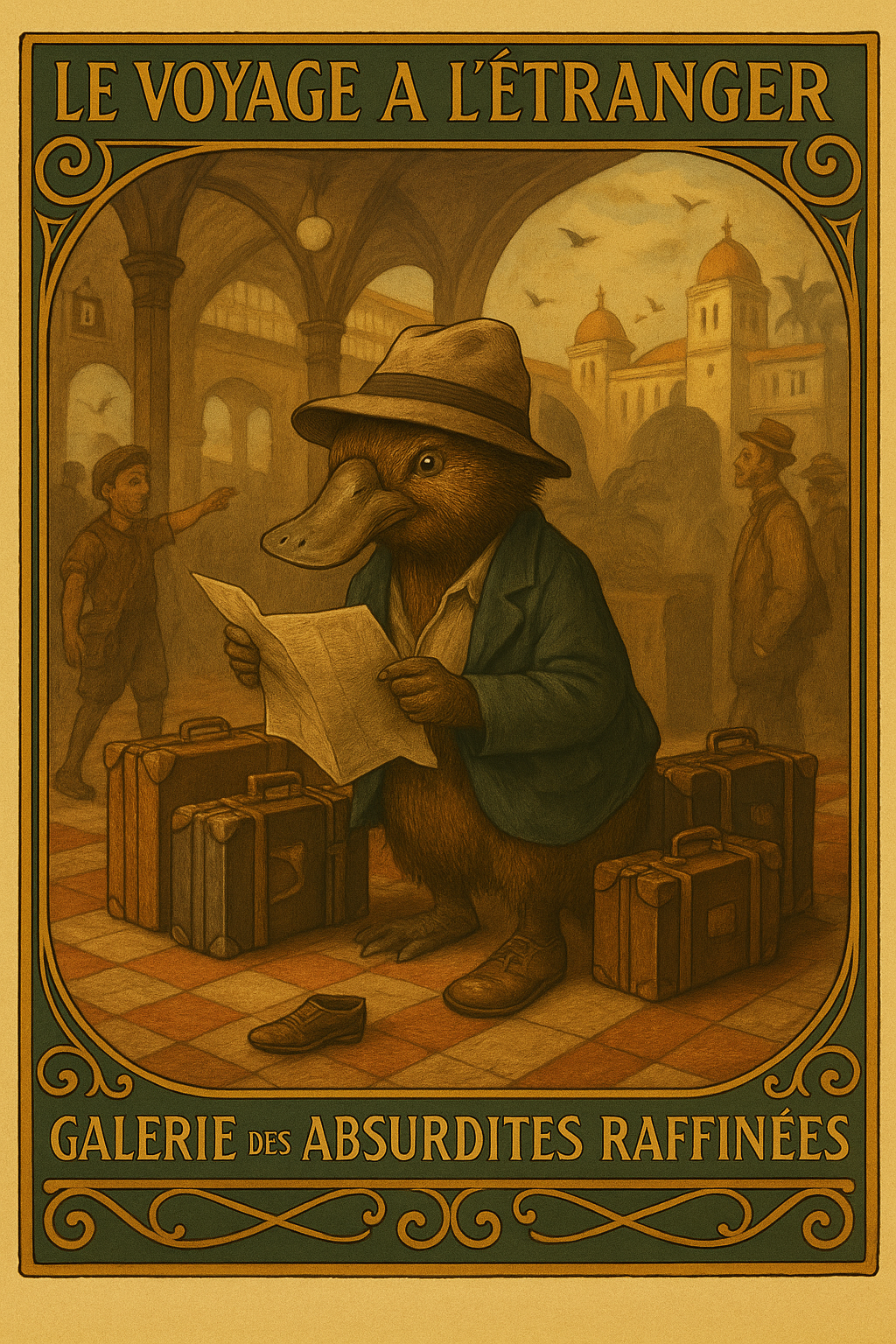
Morocco · Galerie des Absurdités Raffinées · c. 1912
Upon being informed that he was on the wrong continent, he made his way with increasing confusion to Morocco, where he appeared on the cover of several magazines. He found this unexpected. The magazines found it inevitable.
He did not, at any point, approach the Riviera.
The Platypus remains at large.
The aria, it was later agreed, suffered slightly.
The matter came to a head during Monsieur Plume's late summer performance — an event of such social importance that even those disinclined toward opera attended out of principle. Monsieur Plume, the celebrated peacock of the Riviera season, was preparing to deliver the evening's most celebrated aria, his great fan of rival peacocks' tail feathers spread in full ceremonial display behind him.
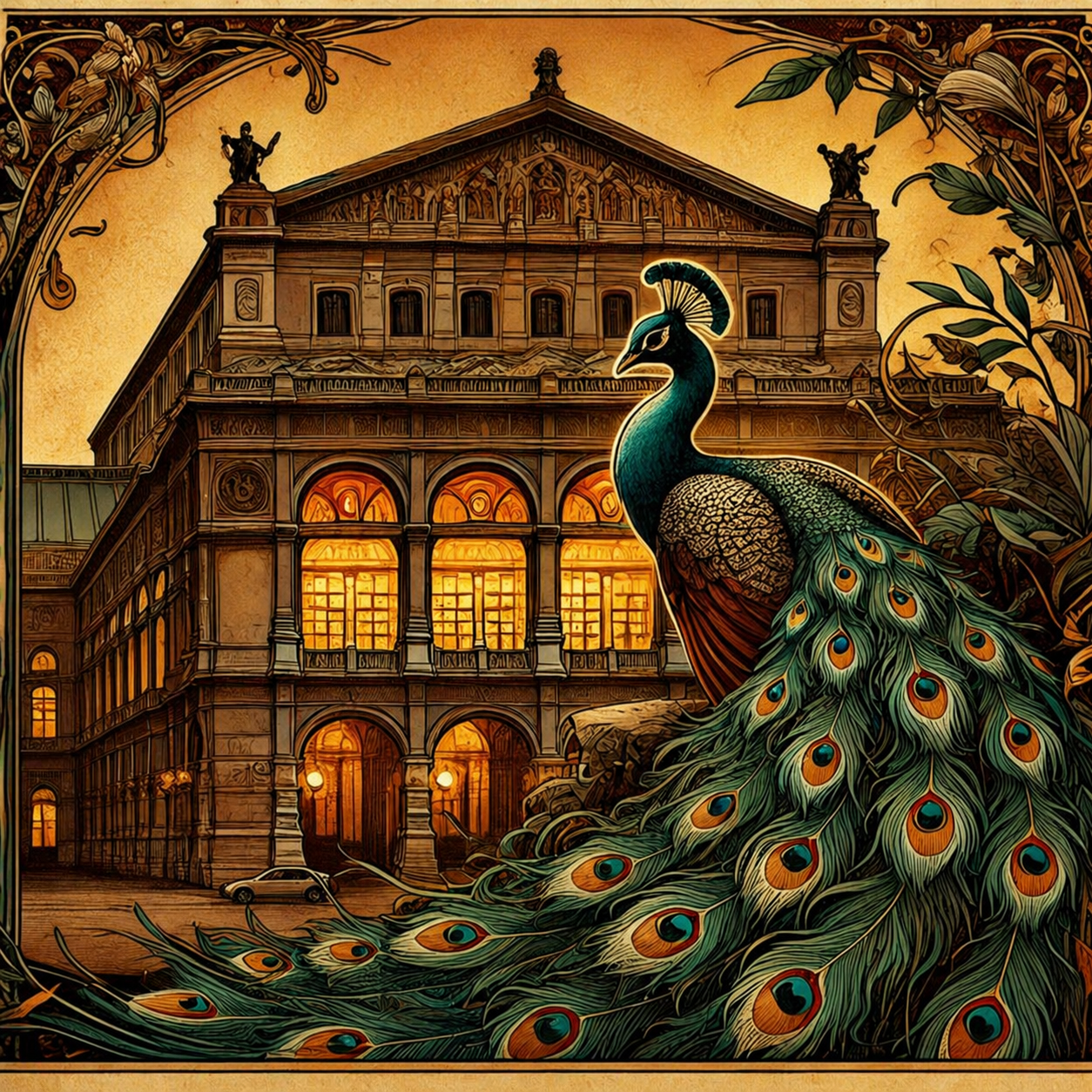
Monsieur / Madame Plume before the Grand Opera House · Late Summer · c. 1912 · Painter unattributed
Mr. Wellington leapt upon the stage. He indicated the Countess in her box with considerable enthusiasm. He declared, before an audience of witnesses, that she was under arrest.
There followed a brief silence.
Mr. Wellington then removed his zebra disguise. He was, in fact, a lemur.
Monsieur Plume fainted. The Countess sighed. Those familiar with her circumstances understood this to be less an interruption and more a recurrence.

Sir Stripes Wellington encounters the Countess Giraffieri and a companion of refined taste · The Riviera · c. 1912 · The Lace Affair · Cognancy Institut des Plumes Disparues, Accession #NB-1912-08
She accompanied Mr. Wellington with the composure of one accustomed to being dramatically accused in public settings, and was conveyed to a discreet office in which Mr. Marmelstein awaited with evident anticipation. He implored her, with what he believed to be sincerity, to return to London. She declined.
Mr. Marmelstein, though visibly disappointed, remained optimistic. He departed shortly thereafter via a private conveyance of uncertain mechanical principles, expressing confidence that the matter was, if not resolved, at least ongoing.
The Countess returned to her seat in time for the conclusion of the evening's program.